What's the Best AI Tool for a Small Business in 2026?
There's no single best AI tool — there's a best one per job. Here's how to pick across assistants, automation, and CRM in 2026, with real price ranges and none of the FOMO.

Evolvv Strategies
Operator notes
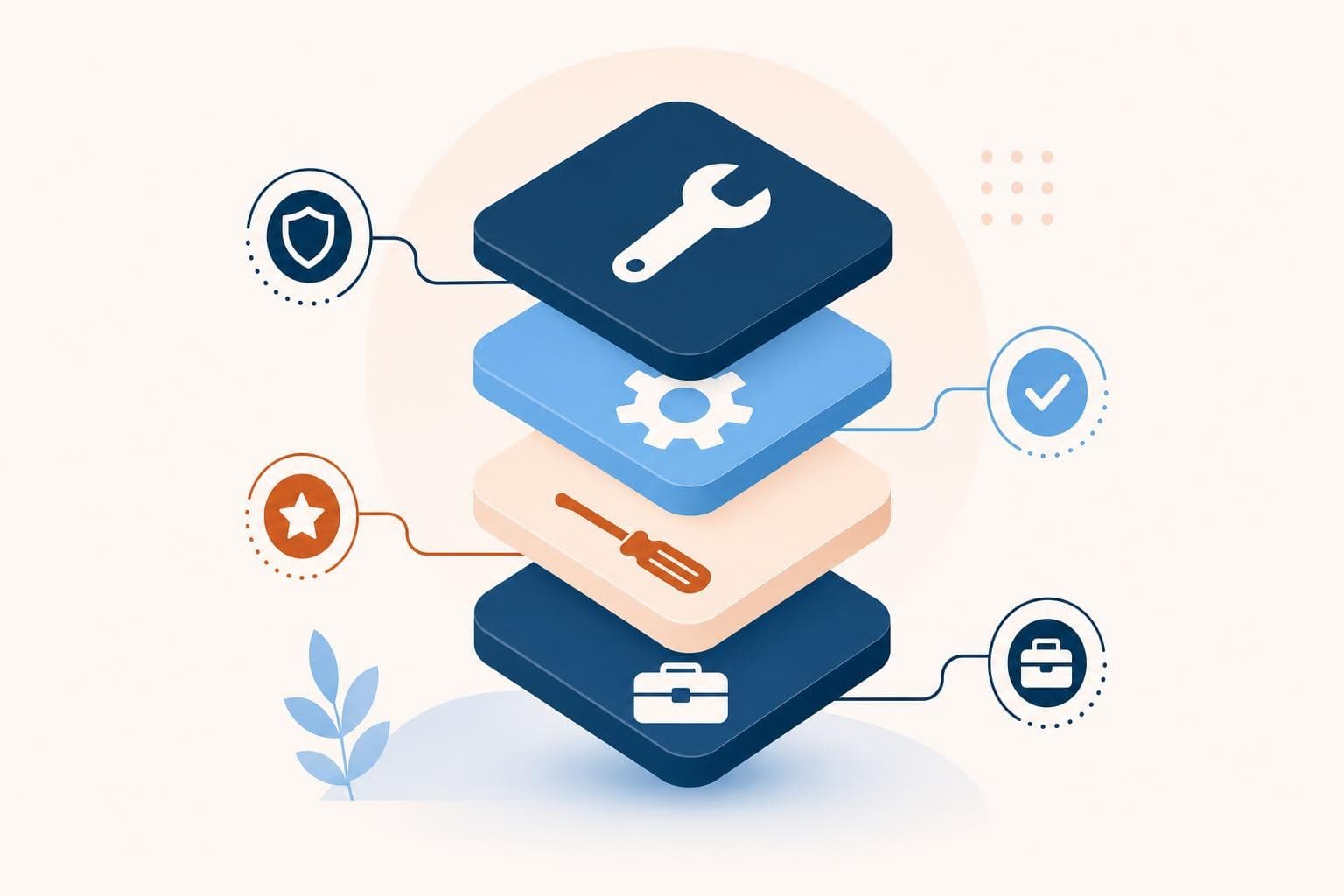
There's no single best AI tool for a small business — there's a best tool per job. Start with one general assistant (ChatGPT, Claude, or Gemini, each around 20 dollars a month) for thinking and writing, add an automation hub (Zapier, Make, or n8n — all with free tiers) to connect your apps, and only adopt specialized tools once a real, repeated need appears. Pick by job, not hype.
Every week there's a new "must-have" AI tool and a fresh wave of FOMO. The honest answer to "what's the best one?" is annoying but true: it depends what you're trying to do. Buying tools before you have a job for them is how you end up paying for nine subscriptions you never open.
So let's sort by category, not by hype.
The categories that matter
- General assistant — writing, summarizing, thinking, research. Start with ChatGPT, Claude, or Gemini. Roughly 20 dollars a month for the paid tier.
- Automation hub — connects your apps and triggers AI steps. Start with Zapier, Make, or n8n. Free to begin; paid plans from around 12 to 20 dollars a month.
- CRM with AI — tracks leads and customers, drafts follow-ups. Start with HubSpot's free CRM, or a lightweight alternative; paid tiers begin under 10 dollars per seat.
- AI agents — run multi-step tasks with oversight. Start with the agent features already inside the tools above rather than a separate product.
Start with one general assistant
If you adopt nothing else, adopt one assistant and actually learn it. A capable assistant handles drafting, summarizing, planning, and research — the bulk of an owner's busywork — for around 20 dollars a month. The three big options are close enough in quality that the choice barely matters; the leverage isn't the tool, it's the habit of reaching for it before doing things the slow way.
The best AI tool is the one you'll actually open every day. A perfect tool you never touch beats nothing — by exactly nothing.
Claude vs ChatGPT vs Gemini — which assistant?
All three big assistants land near 20 dollars a month for the individual paid tier and cover the vast majority of small-business needs. In broad strokes: ChatGPT is the default all-rounder with the widest feature set; Claude is strong for writing, careful reasoning, and working with documents; Gemini fits most naturally if you already live in Google Workspace, where it's bundled into the business plans. Honestly, pick one, get the paid tier, and go deep — fluency beats brand-shopping.
How to choose without the FOMO
Use a simple filter before adding any tool:
- What specific, repeated job is this for? No job, no tool.
- Does it connect to what I already use? Islands create more work, not less.
- Can I be running it this week? If setup is a project, it's probably premature.
- Is the time saved worth the cost? Do the rough math before you subscribe.
Don't tool-stack ahead of need
I've watched owners buy a CRM, an AI writer, a scheduler, and a chatbot in one month — then use none of them, because there was no underlying process for any of it to plug into. Tools amplify a system; they don't replace one. Build the workflow first, then add the tool that removes the friction. My guide to automating your small business with AI walks through finding those workflows first.
Here's what I'd actually do this month
Pick one assistant and use it daily for two weeks on real work. Add an automation hub only when you have a specific repetitive task to wire up. Resist every other tool until a genuine, recurring need shows up. Less stack, more leverage. When you're ready to hand a real task off, my guides to using AI agents to run parts of your business and the safe way to start using AI in your business are the next steps.
FAQ
Which AI assistant should a small business use?
Any of the big three — ChatGPT, Claude, or Gemini — will cover the vast majority of small-business needs, and all three sit around 20 dollars a month for the paid tier. Rather than agonizing over which is marginally best, pick one, get the paid tier for privacy and capability, and learn it well. Fluency with one tool beats dabbling across all three.
Do I need a separate AI tool for every task?
No, and resisting that urge saves money. A general assistant plus an automation hub covers most jobs. Add specialized tools only when a specific, repeated need appears that your core stack can't handle well. Most owners are better served going deep on two tools than shallow on ten.
Are AI agents worth it for a small business yet?
For narrow, supervised tasks, increasingly yes. Agents that handle a defined multi-step job — drafting routine follow-ups, triaging inbound — can save real time when a human stays in the loop, and they're now built into assistants and automation hubs you may already pay for. Avoid handing an unsupervised agent anything customer-facing or money-related until it's earned trust on smaller jobs.
How much should I budget for AI tools?
Most small businesses do well on 50 to 150 dollars a month total — a paid assistant near 20 dollars, an automation hub from around 12 to 20 dollars, and maybe one specialized tool. The bigger cost is setup time, not subscriptions. Start lean, measure the hours saved, and only add tools whose payback you can actually see.
Not sure where AI fits your business? A free Growth Audit shows the highest-payoff spot, and our Operations & Automation work sets it up.