
Start here
What this course builds — and what it really costs
This is the lesson that earns the course its credibility, because it does the thing most ads courses carefully avoid: it puts the real numbers on the table before you spend a dollar. What a click costs. What a lead costs. What a budget actually buys. And why the math still works — if, and only if, the phone gets answered. Nothing here is a promise; these are planning numbers, dated and sourced, so you walk in with honest expectations instead of finding them out at invoice time.
The whole arc, one sentence each
Before the money, the map. Here’s where the next seven modules take you: m1 decodes the results page and helps you decide between Local Services Ads and Search. m2 stands up your pay-per-lead LSA profile with the Google Verified badge. m3 builds your first Search campaign, dodging the Smart-campaign trap. m4 waste-proofs it with negatives, Presence targeting, and a schedule that answers. m5 drafts the ads and the landing page in your voice and walks you through launch day. m6 turns on free tracking and teaches the five numbers that matter. m7 keeps it running — scale rules, kill rules, and when help is honestly worth hiring. Now the part that decides whether any of it is worth doing: the money.
What a click costs
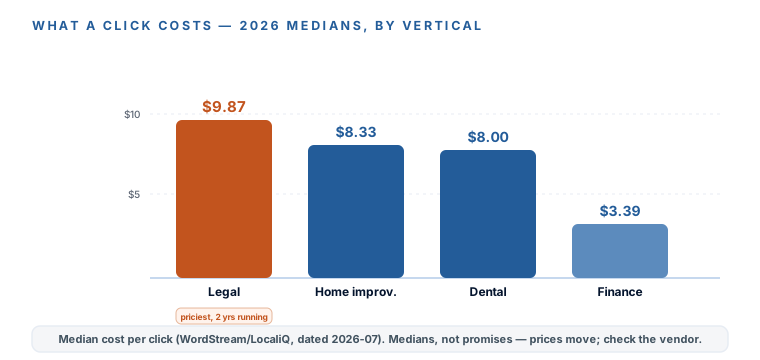
These are 2026 US median figures from WordStream by LocaliQ — a large-sample vendor study (13,474 search campaigns), verified 2026-07-16. Medians, not promises; your account will differ. And the standing rule for every number in this course: prices and platform rules move — check the vendor’s page before you rely on a figure.
- Legal — $9.87 a click. The single most expensive of 23 industries, two years running, up about 15% in a year.
- Home improvement — about $8.33 a click.
- Dental — about $8.00 a click.
- Finance and insurance — about $3.39 a click.
What a lead costs
A click is someone arriving; a lead is someone actually reaching out. On Search, the same 2026 study puts legal at about $131.63 per lead — the highest of every industry — and dental at about $73. On Local Services Ads, where you pay per lead directly, expect roughly $50 to $300 per lead, legal at the high end. That LSA range is deliberately wide: published LSA benchmarks have no rigorous public methodology, so treat single-vendor point estimates (you’ll see figures like “estate $45, personal injury $249” floating around) as the un-verified vendor guesses they are. The only benchmark that will ever matter is your own account, and m6 teaches you to read it.
| Vertical | Cost per click | Cost per lead (Search) | Cost per lead (LSA) |
|---|---|---|---|
| Legal | $9.87 | ~$132 | High end of $50–300 |
| Home services | ~$8.33 | — | Mid-range |
| Dental | ~$8.00 | ~$73 | Mid-range |
| Finance & insurance | ~$3.39 | — | — |
This is the course’s standing defense, and it protects you exactly as much as it protects us. Every figure here is a median or a range, dated 2026-07, from a study with a named sample. No agency, vendor, or course — this one included — can promise you a cost per lead, a lead count, or a timeline. If someone does, that’s not confidence, it’s a sales tactic. Your numbers will be your numbers, and you’ll know them in about six weeks.
What a budget actually buys
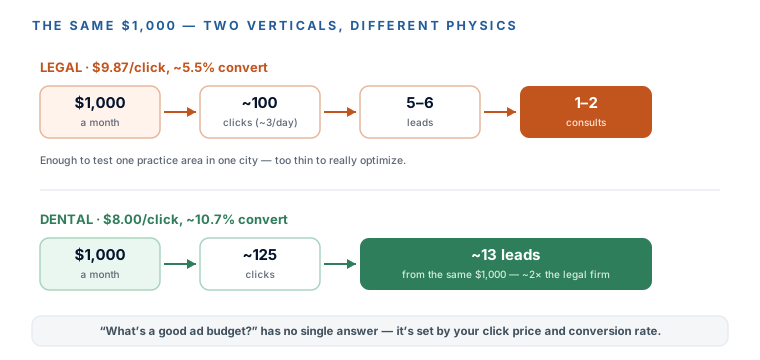
Now the arithmetic, shown rather than asserted, because this is where the honesty lives. Take legal at about $9.87 a click and a roughly 5.5% conversion rate — the share of clicks that become leads.
A worked example — legal at $1,000/month (fictional planning math)
- $1,000 a month buys about 100 clicks, which is about 5–6 leads — roughly 3 clicks a day. Enough to test one practice area in one city. Too thin to really optimize, and too thin to feed Google’s automated bidding, which wants more data than that.
- $2,000–$3,000 a month is the honest floor for a competitive legal metro — about 11 leads at $2k, 16–17 at $3k. Now you have enough data to actually improve.
- A dental practice, at a cheaper click and a much higher conversion rate, gets about 13 leads from the same $1,000. Same money, completely different physics — which is why cheaper verticals genuinely can run on $1k and legal usually can’t.
Why it can still be the best money you spend
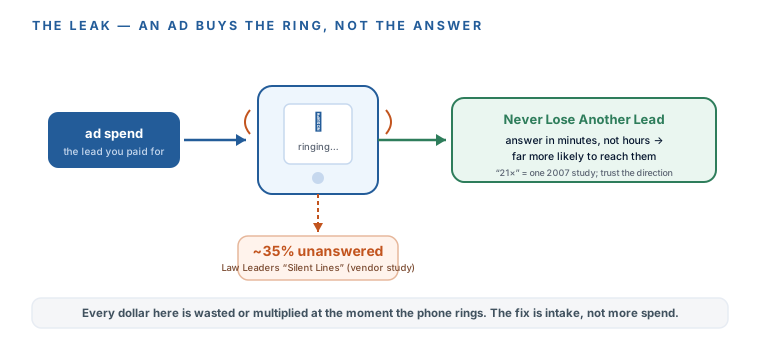
A lead at $130 sounds expensive until you weigh it against the job. One signed family-law client is worth thousands; at a decent consult close rate, even legal’s numbers pencil out with room to spare. But that whole calculation rests on one hinge: the phone getting answered. Roughly 35% of law-firm calls go unanswered — that’s the “Silent Lines” study from Law Leaders, a vendor-run study, cited as such. And speed matters enormously: answering in minutes rather than hours dramatically raises your odds of ever reaching a lead. You’ll see a famous “21 times more likely in five minutes” figure quoted everywhere — it traces to a single 2007 vendor study (MIT / InsideSales, often mis-attributed to Harvard), so treat the exact number as folklore and the direction as solid. Read those two points together and it’s stark: every dollar in this course is either wasted or multiplied at the moment your phone rings. That’s the whole reason Never Lose Another Lead and Evolvv’s Intake & Conversion Engine exist — they’re the answering system these ads pay for.
Set your own numbers before you spend
Don’t take my medians — run yours. Paste the prompt below into ChatGPT or Claude (the free tier is fine), fill in the four brackets, and you’ll get your own planning numbers: expected clicks, leads, cost per lead, how many leads it takes to sign one client, and a blunt verdict on whether your budget is worth testing, too thin, or not yet viable. Then drop those numbers into the Budget & Expectations Worksheet below — the first real file in your Local Ads Kit.
Copy this prompt — budget reality check
Help me set honest expectations for Google ads before I spend anything.
- My business: [WHAT YOU DO] in [TOWN/METRO].
- My monthly ad budget: $[AMOUNT].
- What a new client is roughly worth to me (fee or lifetime value): $[AMOUNT].
- Roughly what share of consultations I win: [e.g. "half"].

Using these 2026 US benchmarks (medians from WordStream/LocaliQ; my numbers will differ): legal ~$9.87/click and ~5.5% of clicks becoming leads; dental ~$8.00/click and ~10.7%; home services ~$8.33/click and ~8%; other local services somewhere in between.
1. Estimate my clicks per month, leads per month, and cost per lead.
2. Estimate how many leads I need to sign ONE client, and what that client costs me in ad spend.
3. Tell me plainly: at my budget, is this worth testing, thin, or not viable — and what budget WOULD make it viable.
Show the arithmetic simply. No hype, no promises — these are planning numbers, not guarantees.
You’ve seen the whole arc — m1 to m7, one sentence each — and, more importantly, you’ve done the honest money talk before spending a cent. You know what a click costs in your vertical (legal $9.87, the priciest of 23 industries; dental ~$8; finance ~$3.39, all 2026 medians), what a lead costs ($131 on Search in legal, $50–$300 on LSA), and what a budget really buys — $1,000 is 5–6 legal leads but ~13 dental ones, same money, different physics. You know why $2–3k is legal’s honest floor, why the math still works when a client’s worth thousands, and why it all hinges on the phone getting answered. You’ve set your own numbers with the prompt and filled the Budget & Expectations Worksheet. And you’ve internalized the standing rule: anyone quoting a guaranteed cost per lead is selling. Next: the $0 tool stack — every tool you need, and every place a dollar could sneak in, surfaced now.
More learning resources
Still want another angle? These are hand-picked and vetted to line up with this lesson — from creators and sites worth your time.