
Module 1 · How Google's paid surfaces work
LSA vs Search: the decision rule
Time to turn the picture into a decision. By the end of this lesson you’ll have a firm, personal answer — Local Services Ads first, Search first, or both — and you’ll have reached it with an explicit rule rather than a gut feeling. There’s one decision rule, it’s short, and the rest of the lesson just walks you through applying it to your own firm.
The rule, stated flat
Here it is, then we’ll unpack every piece:
If your category qualifies for LSA and your market has LSA volume, start with LSA — then add Search to capture what LSA can’t reach. If LSA doesn’t serve you, Search is your whole game, and this course still works start to finish.
Why lead with LSA? Three reasons, all of which matter more on a small budget. You pay per lead instead of per click, so a quiet week or a page full of tire-kickers doesn’t drain you. The Google Verified badge lends you borrowed trust before anyone’s spoken to you. And LSA sits physically above everything else on the page. On a $1–3k budget, lower risk plus higher placement plus borrowed trust is a strong first dollar.
Does your category qualify?
LSA now spans 70-plus business types across home, professional, health, and more — Google adds categories without announcing them. The ones most relevant to this course:
- Lawyers — yes. Industry sources list roughly 17 eligible practice areas (bankruptcy, business, criminal, DUI, estate planning, family, immigration, personal injury, tax, and more). That exact list is industry-sourced, not one clean Google page — so treat it as a strong hint and confirm yours in-account when you start the signup.
- Accountants and tax preparers, financial planners, real estate agents — yes, with license checks.
- Healthcare-adjacent (dentists, chiropractors, optometrists, and similar) — yes, but you’ll need an NPI and malpractice insurance. One important catch: the automated junk-lead credits do not apply to healthcare, so tighten your setup extra carefully (m2 shows you how).
- The whole home-services family (HVAC, plumbing, electrical, roofing, landscaping, and more) — yes; this is the most established group.
| Category | LSA? | The catch to know |
|---|---|---|
| Lawyers | Yes | State-bar check per attorney; ~17 practice areas — confirm yours in-account |
| Accountants, planners, real estate | Yes | License checks |
| Healthcare-adjacent | Yes | NPI + malpractice insurance; junk-lead credits don't apply |
| Home services | Yes | The most established group — trades add background checks |
Who doesn’t qualify: a niche practice area outside the eligible list, and some rural or small markets where LSA simply hasn’t rolled out or has too little search volume to matter. There’s no need to guess — the honest check is to start the LSA signup and see what Google actually offers for your category and your zip. That eligibility step is a real screenshot you’ll walk through in m2.
What Search reaches that LSA can’t
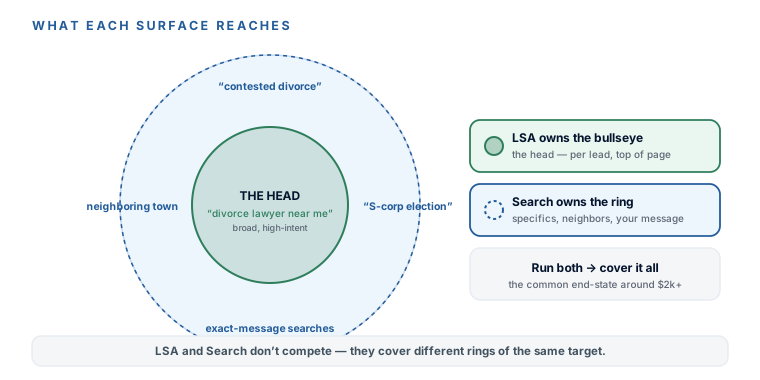
Even when LSA qualifies, it doesn’t cover everything — and that’s where Search earns its place rather than competing with LSA. Search reaches:
- Specific sub-services. LSA shows you for the broad category; Search lets you bid on “contested divorce” or “S-corp election” — the exact thing someone typed.
- Neighboring towns LSA won’t cover for you but where you happily take clients.
- Searches where you want to control the message and the page — your exact ad copy, your exact landing page, tuned to one service.
LSA owns the head
- The broad, high-intent “near me” searches
- Sits above everything on the page
- Borrowed trust from the Verified badge
- Pay per lead — safe on a small budget
Search owns the ring
- Specific sub-services (“contested divorce”, “S-corp election”)
- Neighboring towns LSA won't cover for you
- Searches where you control the exact message and page
- Run both and you cover the whole target
When it’s both
For many firms — especially legal with a budget around $2k or more — the end state is both: LSA capturing the high-intent “head” searches at the top of the page, and Search capturing the specifics and the neighboring geography LSA misses. You don’t have to launch both at once, and you shouldn’t. LSA first (its verification takes weeks anyway, so it needs starting today), Search added once the LSA machine is running. The next lesson turns whatever you decide here into a written one-page plan.
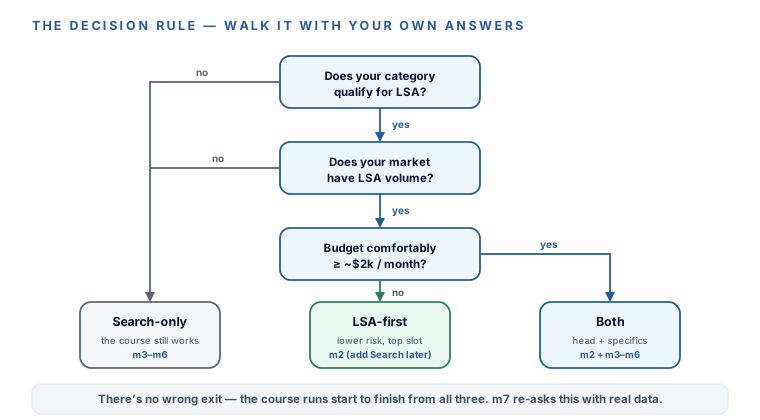
You’re making a starting call, not a lifelong vow. m7’s monthly pass re-asks this exact question with real data in hand — maybe you started LSA-only and your budget grew into Search; maybe Search never penciled out in your metro and LSA-only turned out to be the honest answer. Decide well now, revisit later. That’s the whole game.
You have a firm, personal answer, reached by rule and not by vibes: LSA first, Search first, or both. You know why LSA leads on a small budget — pay per lead, borrowed trust from the Verified badge, top placement. You know whether your category qualifies (and that the honest final check is starting the signup and seeing what Google offers your zip). You know what Search reaches that LSA can’t — specific sub-services, neighboring towns, and searches where you control the message — and that for many firms around $2k the end state is both, LSA first and Search added once it’s running. And you know the decision is revisitable in m7 with real data. Next: everything from m0 and m1 lands on one page you fill in — so every later module is execution, not decision.