
Module 1 · How Google's paid surfaces work
Your one-page ad plan
Everything from the last four lessons comes together on a single page now — and once it’s filled in, every remaining module is pure execution instead of decision. The One-Page Ad Plan captures your surface choice, your budget split, the one thing you’re advertising, your honest expectations, your readiness gates, and the rule that keeps you from panicking in week two. We’ll walk it section by section, filling it live, then pressure-test the whole thing with AI before you spend a dollar.
- §1
Your surface, and the split
LSA, Search, or both — and the budget split if it’s both (a $1k / $1.5k default at $2.5k). - §2
The one thing you’re advertising
One service, one town. The section that saves the most money — depth beats breadth at this budget. - §3
Your expectations
The clicks, leads, cost per lead and leads-to-sign from your m0 prompt — what stops week-three panic. - §4
Your readiness gates
A verified GBP, a phone that gets answered, a real service page — catch a gap cheaply, before spend. - §5
The 60-day rule
No judging, panicking, or restructuring for 60 days — how you avoid expensive decisions on noise.
§1 — Your surface, and the split if it’s both
Carry over your answer from the last lesson: LSA, Search, or both. If it’s both, this is where you set the budget split. A sensible default for a legal firm at $2,500 a month is roughly $1,000 to LSA and $1,500 to Search — LSA catching the head searches, Search catching the specifics. That’s a starting split, not a law; you’ll rebalance with real data in m7. If you’re running one surface only, the whole budget goes there and this section takes ten seconds. (All figures dated 2026-07 — prices move; check the vendor’s page.)
§2 — The one thing you’re advertising
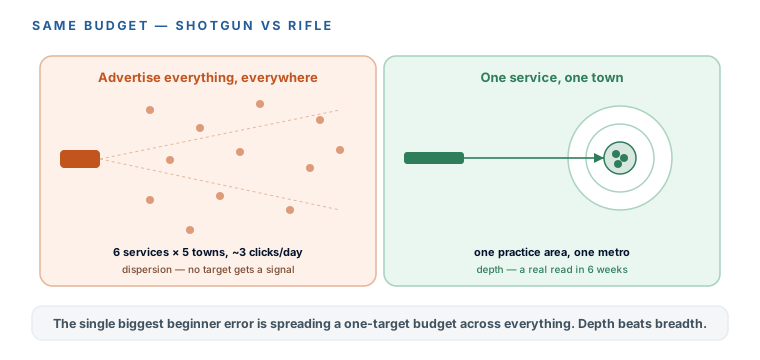
This is the section that saves the most money, so don’t rush it. Pick one practice area or service, in one town, to start. The single biggest beginner mistake — the one that quietly burns budgets — is advertising everything, everywhere, on a budget that can only really test one thing. Remember the math from m0: $1,000 in legal is about three clicks a day. Spread that across six practice areas and five towns and you learn nothing about any of them. Point it all at “family law in one metro” and you get a real read in six weeks. Depth beats breadth every time at this budget.
§3 — Your expectations
Bring over the numbers you generated with the m0 budget prompt: expected clicks a month, leads a month, cost per lead, and how many leads it takes to sign one client. Writing them down matters more than it sounds — in week three, when the account is quiet, these are what stop you from panicking. You set honest expectations up front precisely so you can hold your nerve later.
§4 — Your readiness gates
Three things need to be true before launch, and if one isn’t, this is where you catch it — cheaply, before spending — instead of discovering it after.
- A verified Google Business Profile. LSA flat-out requires it as of 2026 — no GBP, no LSA — and it feeds your reviews. If yours isn’t verified, Get Found First is the fix; start it in parallel.
- A phone that gets answered in business hours. The one I keep hammering. If calls go to voicemail while you’re in a meeting, fix the answering before you buy the traffic — that’s Never Lose Another Lead, and it’s the honest “fix this first” pointer, not an upsell.
- A page to send clicks to. Not your bare homepage — a page about the one service you’re advertising. If yours is weak or missing, m5 fixes exactly that, so note it and keep going.
A verified Google Business Profile
LSA flat-out requires it as of 2026, and it feeds your reviews. Not verified? Get Found First is the fix — start it in parallel.
A phone that gets answered
In business hours, by a human. If calls go to voicemail, fix the answering first — Never Lose Another Lead — before you buy traffic.
A page to send clicks to
About the one service you're advertising, not the bare homepage. If yours is weak or missing, m5 fixes exactly that.
§5 — The 60-day rule
Write this one down and mean it: you will not judge, panic, or restructure this account for 60 days. Here’s why it’s not just patience-for-its-own-sake. LSA verification alone takes three to four weeks to clear. Search needs a meaningful pile of clicks before its numbers mean anything statistically. Restructure on day nine and you’ve thrown away the only thing that makes the data trustworthy — time. The 60-day rule isn’t faith; it’s how you avoid making expensive decisions on noise.
Almost every beginner who “fails” at Google Ads actually succeeds at self-sabotage: they get nervous around day ten, start flipping settings daily, and never let any version of the account run long enough to prove itself. The account that wins is boring — set it up right, hold your hand off the controls, read it once a week (m6), and decide monthly (m7). Sixty days before verdict.
Pressure-test the plan before you spend
Before you print this and start building, hand the whole plan to AI and ask it to find the weak link. Paste the prompt below into ChatGPT or Claude (free tier is fine), fill in your real answers, and it’ll tell you what breaks first, whether your budget honestly matches your vertical, and the one or two things to fix before launch. Better to hear it now, from a robot, than in six weeks from your bank statement.
Copy this prompt — plan pressure-test
Pressure-test my Google ads plan before I spend money. Be blunt — I'd rather hear it now.
- My business: [WHAT YOU DO] in [TOWN].
- Surface(s) I chose and why: [e.g. "LSA first — family law qualifies and my metro has LSA; adding Search later"].
- Monthly budget and split: $[AMOUNT], split [e.g. "$1k LSA / $1.5k Search"].
- The ONE service I'm advertising first: [SERVICE].
- My expectations from the benchmarks: ~[N] leads/month at ~$[CPL] per lead.
- My readiness: Google Business Profile verified? [Y/N]. Phone answered live during business hours? [Y/N/mostly]. A real page for this service on my site? [Y/N].

1. Name the weakest link in this plan and what breaks first because of it.
2. Tell me if my budget matches my vertical honestly (legal usually needs $2–3k/month to be optimizable; cheaper verticals can run on $1k).
3. Give me the two things to fix BEFORE launch, if any.
Keep it specific to my situation. No generic ads advice.
![A filled-in example One-Page Ad Plan for a solo family-law firm: §1 Surface — 'LSA first, then Search', split $1k / $1.5k of $2.5k. §2 The one thing — 'Divorce, [one metro]'. §3 Expectations — '~11 leads/mo at ~$130'. §4 Readiness gates — GBP verified ✓, phone answered ✓, service page ✓. §5 — 'No changes for 60 days'.](/course/google-ads-local/art/ga-fig-m1-oneplan.svg)
You’ve got a written, one-page plan — and from here on, every module is execution rather than decision. Your surface is chosen and, if it’s both, split (a $1k / $1.5k default for legal at $2.5k). You’ve committed to one service in one town, because depth beats breadth at this budget and the shotgun teaches you nothing. Your expectations are written down so week-three quiet doesn’t rattle you. You’ve checked the three readiness gates — a verified GBP, a phone that gets answered, a real service page — and you know which sibling course fixes each gap. And you’ve locked in the 60-day rule: no judging, no panicking, no restructuring, because data needs time to mean anything. You’ve pressure-tested the whole thing with AI and filed it as the front page of your Kit. Next module, Session 1’s payoff: your live Local Services Ads profile, built end to end.