
Module 7 · Keep it running, scale it, or hand it off
PMax, broad match, and Google's other suggestions
Your interface is about to become a salesperson. Google will suggest, nag, and auto-recommend constantly — a badge that says your account is only 74% “optimized,” a prompt to switch to broad match, a friendly nudge toward Performance Max. Some of it is real advice. Most of it optimizes Google’s revenue on your account, not your results. You don’t need a grudge; you need a sorting rule. This lesson gives you one, then applies it to the three big ones — Performance Max, broad match, and the click-fraud tools someone will absolutely try to sell you.
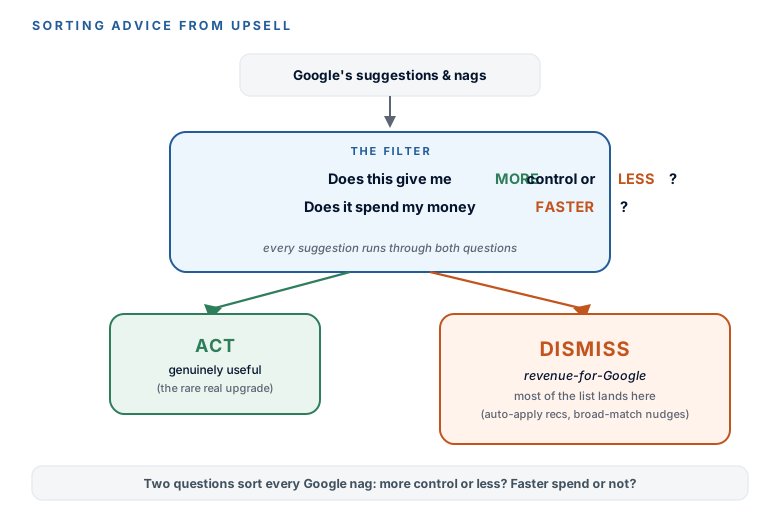
The sorting rule — two questions
Run every suggestion Google makes through two questions, and you’ll almost never be wrong. Does this give me more control, or less? And does it spend my money faster? A recommendation that hands control to an automated system and speeds up your spend is one to dismiss until you’ve got a specific reason not to. A recommendation that tightens targeting, adds a negative, or fixes a genuinely broken setting is one to act on. It’s not paranoia — it’s just remembering that Google’s defaults are built for Google, and reading each nudge with that in mind.
Performance Max, honestly
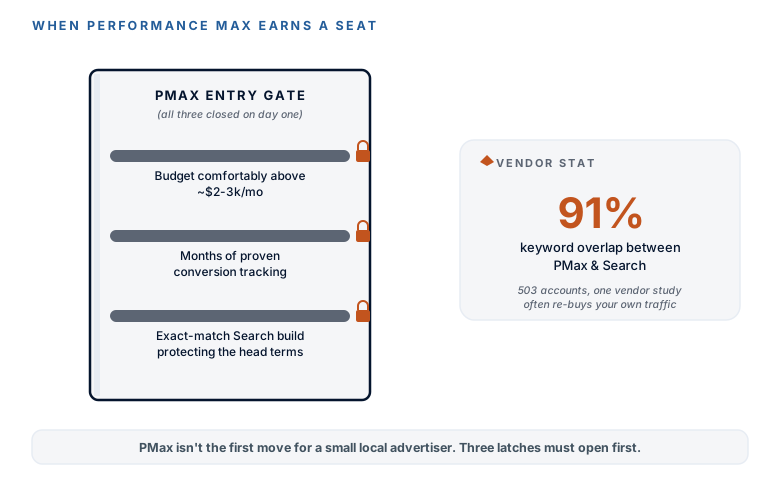
Performance Max is one automated campaign that runs across Search, Display, YouTube, Gmail, and Maps at once. The interface pushes it hard, and for a small local advertiser it is not your first move — say it plainly, because this contradicts Google’s own automation-first prompts. On a small budget it spreads your money thin across surfaces you never chose, hides most of your search-term data in a black box, and needs feeding: practitioners peg a rough $1–2k/month minimum just to give it enough data to learn. And it can quietly re-buy traffic you already own — one vendor study of 503 accounts found about 91% keyword overlap between PMax and Search (a vendor figure, flagged as such), meaning PMax often spends to win clicks your exact-match Search terms would have won anyway, cheaper.
When does it earn a seat? Three things, all of which a day-one account lacks: a budget comfortably above ~$2–3k, conversion tracking proven for months, and an exact-match Search build protecting your head terms — because an exact-match keyword wins the auction over PMax when a query matches it, so your Search build is the moat that stops PMax cannibalizing your best traffic. Get all three, and PMax becomes an experiment worth running. Before all three, it’s just a faster way to spend money you can’t yet track.
Budget above ~$2–3k
Enough to feed one automated campaign across Search, Display, YouTube, Gmail, and Maps without spreading thin.
Tracking proven for months
Conversion data it can actually learn from — not a day-one account still figuring out what a lead costs.
An exact-match Search moat
Exact-match keywords win the auction over PMax, so your Search build stops it re-buying your best traffic (~91% keyword overlap).
Broad match, revisited
Same gate, restated. Back in m3 you started on phrase and exact and locked broad match away. It stays locked until three things exist: Smart Bidding running on real conversion data, enough conversion volume for it to learn from, and an aggressive, well-tended negative list. When you genuinely have all three — months in, tracking solid, negatives sharp — then broad match on one ad group, as an experiment, watched weekly, is a reasonable thing to test. Not before. Broad match without those three is just a license for Google to spend your budget on searches “related to” yours, which at legal click prices is an expensive way to discover new negative keywords.
The optimization score — a checklist in a salesman’s coat
That percentage Google shows you is a useful checklist wearing a sales pitch. Some of its suggestions are real; many are “apply broad match” and “raise your budget” dressed as account health. Never chase 100%. A 100% optimization score means you did everything Google wanted, which is not the same as everything that’s good for you. When you’ve deliberately rejected a recommendation, dismiss it — dismissing is allowed, it doesn’t hurt your account, and it clears the noise so the occasional genuinely useful suggestion stands out.
Click fraud, right-sized
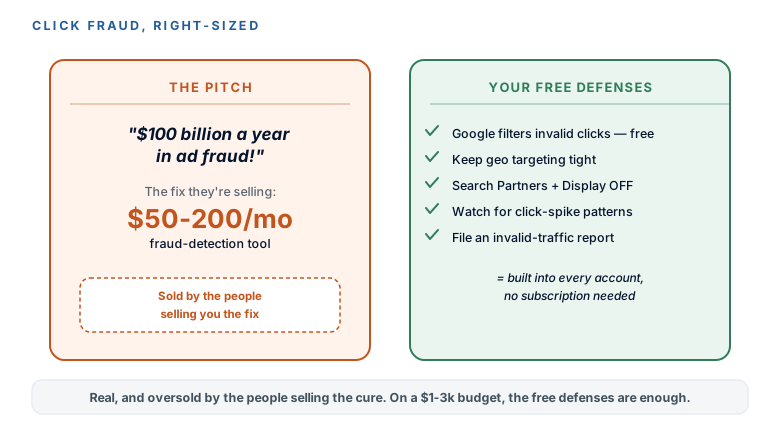
Someone will try to sell you click-fraud protection, and the pitch will be scary: “$100 billion a year in fraud,” “most campaigns affected.” Notice who those figures come from — the companies selling the fix. Click fraud is real, and it’s oversold by exactly the people who profit from your fear. Here’s the honest version: Google already filters invalid clicks for free and doesn’t charge you for the ones it catches, and you can file an invalid-traffic investigation for roughly the last 60 days if you see something wrong. On a $1–3k/month budget your defences are already built — tight geography, Search Partners and Display switched off, and a weekly eye on click spikes. Don’t buy a $50–200/month fraud tool to protect a budget that size; the tool would cost more than the fraud. (Prices and platform rules move — check the vendor’s page before you rely on a number.)
You can tell Google’s genuine advice from its upsells, using two questions: does this give me more control or less, and does it spend my money faster? You know Performance Max is not the first move for a small local advertiser — it earns a seat only above ~$2–3k with months of proven tracking and an exact-match Search moat — and you know why (thin spread, hidden data, ~91% overlap re-buying your own traffic). Broad match stays behind the same gate. You’ll never chase a 100% optimization score, and you’ll dismiss recommendations you’ve rejected without a second thought. And you won’t buy a click-fraud tool you don’t need on a budget this size. Next: the honest guide to hiring help — when it’s worth it, what fair looks like, and how not to get taken.