
Module 7 · Keep it running, scale it, or hand it off
When to hire help — and what fair looks like
This whole course exists because a $1–3k/month account rarely justifies an agency — the management work is now mostly AI-assisted and fifteen minutes a week. But there is a point where help genuinely pays, and an educated buyer gets a far better deal than a scared one. So this lesson does two jobs: it tells you the honest signals that it’s time, and it makes you the kind of client who can’t be taken — you’ll know the pricing models, the conflict baked into the most common one, and the ten-second sniff tests that end a bad conversation fast.
When it’s genuinely time
Three honest signals, and note that two of them are about growth, not rescue:
- Spend growing past ~$5k/month. Above that, real management skill starts to compound — there’s enough budget that a good hand on it earns back their fee and then some.
- Multiple campaigns, locations, or services. Complexity that genuinely exceeds a fifteen-minute weekly routine — several markets, several practice areas, a real matrix to manage. This is also the moment the free Google Ads Editor I flagged back in module 0 finally earns its place: bulk edits across many campaigns are exactly what it’s for. On a single campaign you never needed it — here it starts to pay off.
- Your fifteen minutes a week honestly isn’t happening, and leads are leaking. This one’s an operations problem money can solve. If the routine keeps slipping and the account is drifting because of it, paying someone to hold it is a fair trade — just be honest that that’s what you’re buying.
Spend past ~$5k/month
Above that, real management skill compounds — there's enough budget that a good hand earns back their fee and then some.
Real multi-campaign complexity
Several markets, practice areas, a matrix that exceeds a 15-minute weekly routine — and where the free Ads Editor finally earns its place.
The routine isn't happening
If your 15 minutes a week keeps slipping and leads are leaking, paying someone to hold it is a fair trade — just be honest that's what you're buying.
The pricing models — and the conflict in the common one
Four models, plainly (figures are observed 2026 ranges, vendor-sourced — and, as always, prices move, so treat them as bearings): flat monthly (typically $500–$5,000/mo), percent of spend (10–20% typical, some 15–30%), hybrid, and hourly consulting. The one to understand before you sign anything is percent of spend, because it carries a structural conflict of interest.
| Model | Typical price (2026) | The incentive it creates | When it fits |
|---|---|---|---|
| Flat monthly | $500–$5,000/mo | Aligned to the scope of work | The small-spend default |
| Percent of spend | 10–20% (some 15–30%) | Grows when YOU spend more | Only with a written efficiency target |
| Hybrid | A base plus a percentage | Mixed — depends on the split | Mid-size accounts |
| Hourly consulting | Market rates | Neutral — you pay for time | One-off audits and setups |
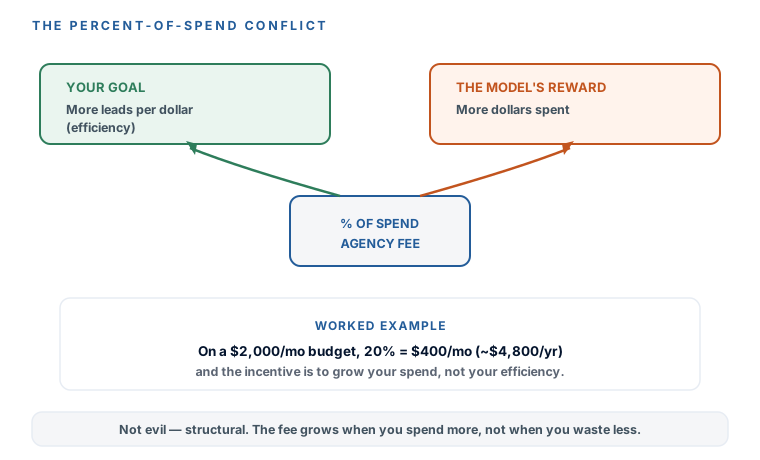
Percent-of-spend pays the agency more when you spend more. That’s not evil — it’s an incentive, and incentives are structural, not moral. But it means the person advising your budget is rewarded for growing it rather than for growing your efficiency. On a $2,000 budget, 20% is $400/month — nearly $4,800 a year — skimmed off a small budget by someone whose incentive is to make that budget bigger. At small spend, prefer a flat fee, or a percent model with a written efficiency target that ties their pay to your cost per lead, not just your total spend.
The sniff tests — and you now know enough to check their work
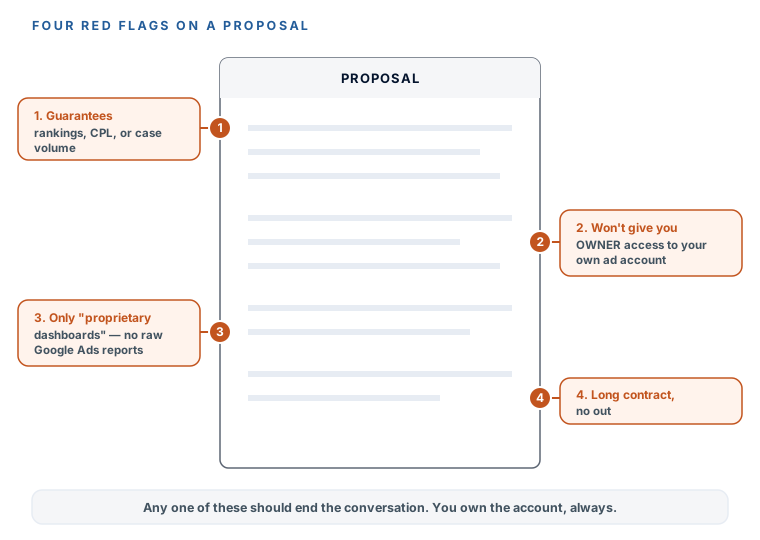
Any one of these should end the conversation:
- They guarantee rankings, cost per lead, or case volume. Nobody honest can; you learned that on day one.
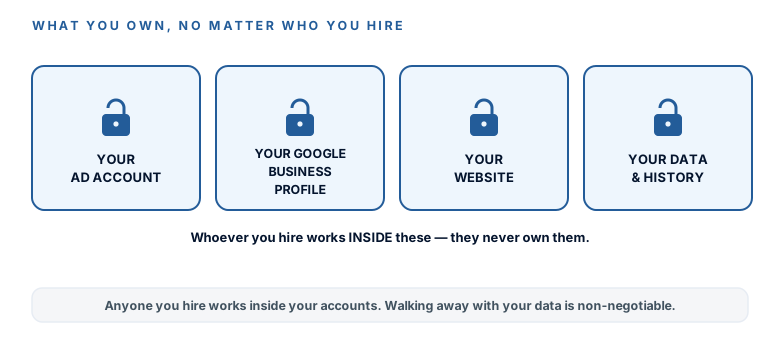
- They won’t give you owner access to your own ad account. You own the account, always — walking away with your data and history is non-negotiable.
- They’ll only show “proprietary dashboards,” never the raw Google Ads reports underneath.
- They want a long contract with no out. Good work earns renewal; lock-in is for work that can’t.
And here’s the quiet power this course just handed you: you can check anyone’s work in your own account. Ask to see the Search Terms report and the Change history — both live in the account you own. A manager doing real work leaves fingerprints in the change history and can show you the searches they’re blocking. One who can’t, isn’t. That’s how you audit anyone you hire — including, honestly, yourself.
Run the proposal past a skeptic
Before you sign anything, paste the pricing and terms into the prompt below. It translates their model into real dollars at your spend, flags every red flag, and hands you the five questions to ask — so you walk in educated instead of hopeful.
Copy this prompt — the proposal sniff test
I'm considering hiring help for my Google Ads. Review this like a skeptical friend who runs
ads himself.
- My spend: $[AMOUNT]/month. My results so far: ~[N] leads at ~$[CPL].
- What they're proposing (paste the pricing, promises, and contract terms):
[PASTE]

1. Translate their pricing into real dollars per month and per year at my spend — and if it's
   % of spend, show what they'd earn if my budget doubled.
2. Flag every red flag: guaranteed results, no owner access to MY ad account, "proprietary"
   reporting instead of raw Google Ads reports, long lock-in, vague deliverables.
3. List the 5 questions I should ask them before signing, and the answer that should end the
   conversation.
4. Honest verdict: at my spend and results, is professional management likely to pay for
   itself, or am I better running my 15-minute routine and revisiting at higher spend?
The deep dive, and an honest word about Evolvv
This lesson is the short version. The full treatment — the vendor-contract red flags, the ten questions to ask, fair 2026 price ranges across every marketing service — is its own course, Don’t Get Burned Buying Marketing, coming to the library; and Marketing 101, also coming, maps the whole channel landscape if you want the survey view. And the honest, unpushy word about us: Evolvv’s model is deliberately the anti-lock-in version of everything above — flat, transparent, and you own every account and every piece of data. If you want a genuinely free second pair of eyes on whether ads are even your bottleneck, the Growth Audit at /audit is exactly that: no cost, no pitch, just a read on where your growth is actually stuck. Sometimes the honest answer is “ads aren’t your problem” — and that’s worth knowing before you hire anyone to run them.
You know the honest signals that hiring help is worth it — spend past ~$5k/month, real multi-campaign complexity, or a fifteen-minute routine that genuinely isn’t happening while leads leak. You know the four pricing models and the conflict baked into percent-of-spend (it pays more when you spend more; $400/mo on a $2k budget, ~$4,800/yr), and you’d prefer a flat fee or a written efficiency target at small spend. You’ve got the four sniff tests — guarantees, no owner access, proprietary-only reporting, lock-in — any one of which ends the conversation, and you know you can audit anyone through the Search Terms report and Change history in the account you own. The deep dive (Don’t Get Burned Buying Marketing) is coming to the library, and the free Growth Audit is there when you want a second opinion. Last lesson: the whole machine, seen at once — and a word from me.