
Module 5 · Ads and landing pages that convert the click
Write responsive search ads with AI
The click costs the same whether your ad is mediocre or great. So the ad is free leverage: a better one earns more clicks from the same impressions and a lower price per click, for zero extra spend. This lesson builds one responsive search ad per ad group — the format Google actually runs today — drafted by AI in your voice, then checked by you against the one rule regulated professionals can’t skip: your state bar’s advertising rules. AI writes fast; you keep it honest.
What a responsive search ad is
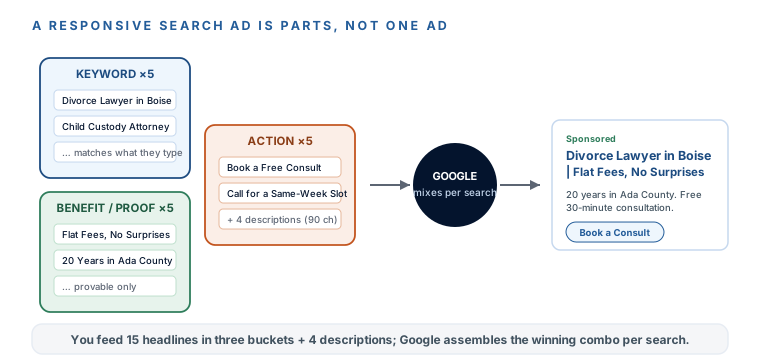
You don’t write one finished ad anymore. You supply the raw materials — up to 15 headlines (30 characters each) and 4 descriptions (90 characters each) — and Google mixes and matches them per search, showing the combination it thinks will win that auction. Your job is to feed it strong, true, on-message parts. One RSA per ad group, and each one speaks that group’s single theme: the custody ad group gets an ad about custody, not a generic firm ad.
The three headline buckets
Good RSA headlines aren’t fifteen ways of saying the same thing. Spread them across three jobs so Google always has a relevant part to reach for:
- Keyword (~5 of them). Match what they typed: “Divorce Lawyer in [Town],” “Child Custody Attorney.” This is the relevance that both wins the click and lowers your price.
- Benefit / proof (~5). Why you, in provable terms: “Flat Fees, No Surprises,” “20 Years in [County],” “Free 30-Minute Consult.”
- Action (~5). Tell them what to do: “Book a Free Consultation,” “Call for a Same-Week Appointment.”
Keyword (~5)
Match what they typed: “Divorce Lawyer in [Town],” “Child Custody Attorney.” The relevance that wins the click and lowers your price.
Benefit / proof (~5)
Why you, in provable terms: “Flat Fees, No Surprises,” “20 Years in [County],” “Free 30-Minute Consult.”
Action (~5)
Tell them what to do: “Book a Free Consultation,” “Call for a Same-Week Appointment.”
Fill all 15 slots — more raw material gives Google more room to find a winning combination. Pin sparingly. Pinning locks a headline to a fixed position and throttles Google’s testing; only do it when compliance genuinely requires a fixed first line (say, a mandated disclaimer). Otherwise let it mix.
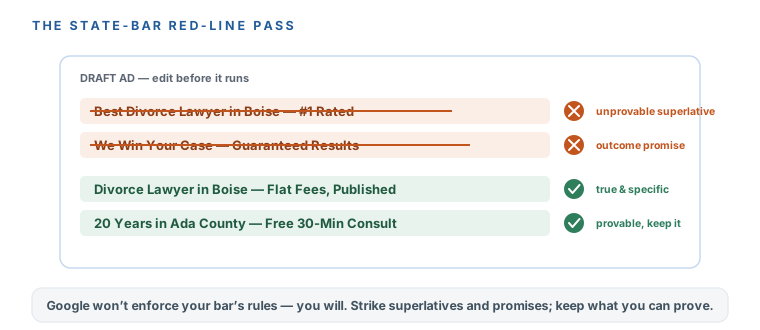
Read this before your first ad runs. General legal advertising is allowed on Google with no special certification — but Google does not enforce your state bar’s rules for you. The recurring offenders that get lawyers in trouble: unprovable superlatives (“best,” “top,” “#1,” and “expert” in some states), outcome promises (“we win”), guarantee language, restrictions on testimonials, and required disclaimers or “advertising material” labels that some states demand. Check your state bar’s advertising rules before your first ad runs. The prompt below bakes the safe defaults in — no superlatives, no promises, no invented facts — but the bar is your responsibility, not Google’s and not this course’s. This isn’t legal advice; it’s the safe default, and the calm way to run ads in a regulated profession.
Let AI draft it, then read every line aloud
Give the prompt your true, provable facts and this ad group’s theme, and it returns 15 headlines and 4 descriptions with the character counts so you’re not counting by hand. Then you read every line aloud, delete anything you can’t prove or wouldn’t say to a client’s face, and paste the survivors into the paused ad group.
RSA generator — one ad group at a time, compliance-first
Draft a Google Responsive Search Ad for one of my ad groups. I'm a regulated professional, so
compliance beats cleverness.
- Business: [NAME], [what you do] in [TOWN].
- This ad group's theme + keywords: [e.g. "child custody lawyer — custody lawyer [town],
  child custody attorney near me"]
- True, provable things about my firm (only these may appear): [e.g. "flat fees published on
  our site; 20 years practicing in [county]; free 30-minute consultation; evening
  appointments"]
- Things my state bar forbids in ads (if I know them): [e.g. "the word 'expert', testimonials
  without disclaimers"]

Write:
1. 15 headlines, each 30 characters or fewer (count carefully): ~5 that include the keyword
   naturally, ~5 built on my true differentiators, ~5 with a clear action.
2. 4 descriptions, each 90 characters or fewer, plain and specific.
Hard rules: no superlatives I can't prove ("best", "top", "#1"), no outcome promises or
guarantees, no urgency theater, no invented facts, no competitor names. Sound like a calm,
competent local professional. After the draft, show me the character count for every line.Google will grade your ad’s Ad strength — aim for “Good” or better, mostly by filling all the slots and keeping headlines varied. But never trade a compliant, true line for a rating. A “Poor” ad that keeps you out of a bar complaint beats an “Excellent” one that doesn’t. Strength is a suggestion; compliance is a wall.
Almost no local firm hits these, but they’re worth one sentence. Bail bond services are banned on Google Ads globally, and addiction / rehab treatment requires third-party LegitScript certification before ads run (fees and timelines are third-party figures, not stated as fact). And if you’re a malpractice, mass-tort, or personal-injury firm naming specific drugs or medical devices, healthcare terminology in your ad or page can auto-restrict the ad — write plainly and you’ll usually be fine. Everyone else: carry on.
Each ad group has one responsive search ad — 15 headlines across the keyword, benefit/proof, and action buckets, plus 4 descriptions — drafted by AI from your true facts and speaking that group’s single theme. You pinned sparingly, aimed for “Good” ad strength without sacrificing a true line for it, and — the one that matters most — you ran every line through the state-bar red-line pass: no unprovable superlatives, no outcome promises, no guarantees, and you know to check your bar’s rules before launch. The ad is written but the campaign stays paused. Next: wiring the phone into it the current, correct way — call assets, not the dead-end everyone still recommends.
Watch this step
Two angles on the responsive search ad: the three-bucket headline method with a local example, plus the in-account build with the AI-assisted-copy workflow this lesson leans on. Take the craft; supply your own provable truth. It’s from an independent creator — credited below, so go give them a follow.
How To Write Google Ads Copy That CONVERTS!
How to Write Google Ad Copy with AI (+ChatGPT Templates)